NDIS Planning Principles and Funding Criteria Study Guide
4/22/2026
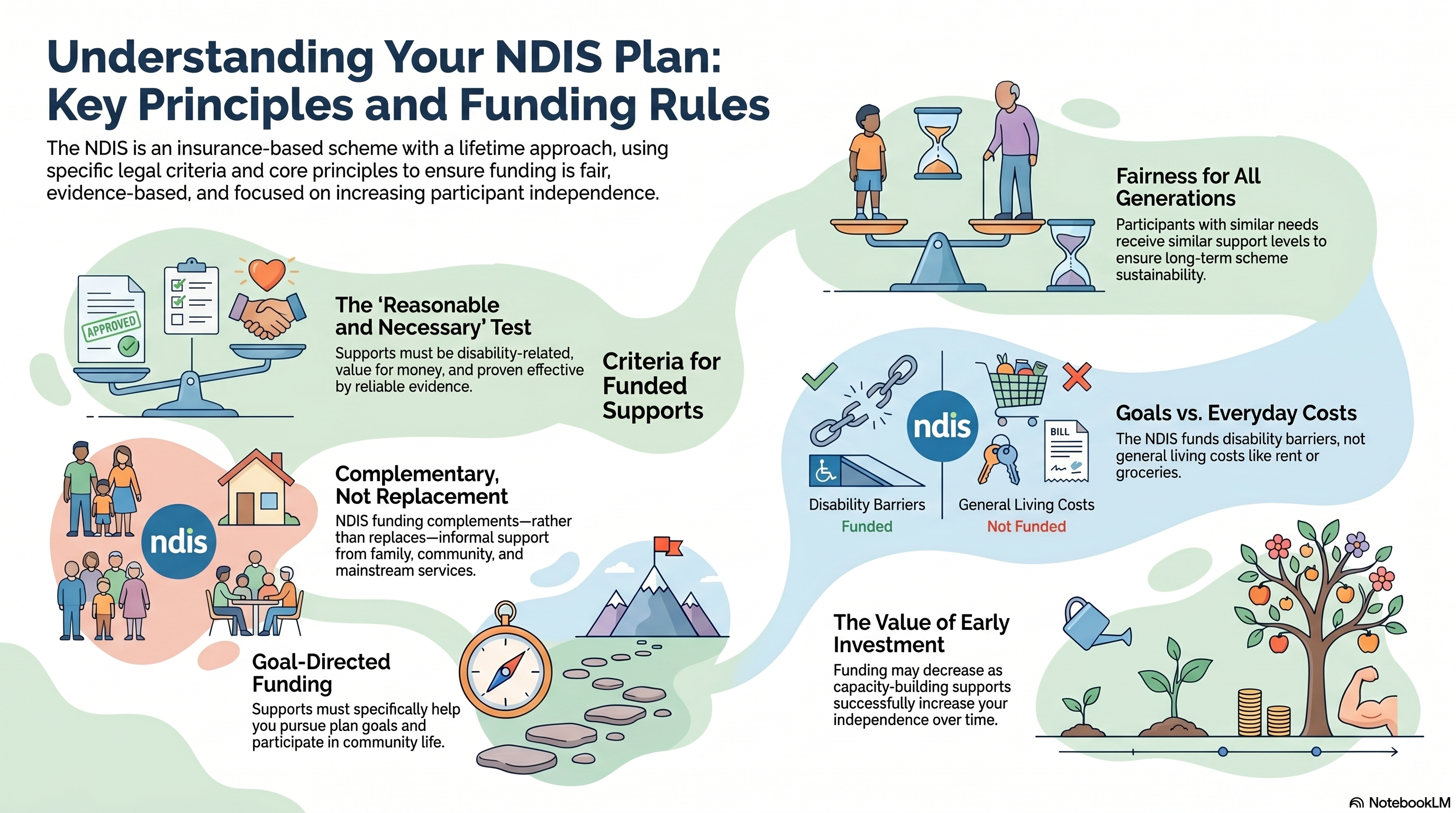
This study guide provides a comprehensive overview of the principles and legislative frameworks used by the National Disability Insurance Scheme (NDIS) to create participant plans. It covers funding criteria, financial sustainability, and the specific principles that ensure fair and consistent decision-making.
Short-Answer Quiz
Instructions: Answer the following ten questions in 2–3 sentences based on the provided guidelines.
- What is the legislative basis for the NDIS, and how does it position the participant in the decision-making process?
- How does the NDIS define "value for money" when assessing a support?
- What is the distinction between the "old framework" and the "new framework" for planning mentioned in the document?
- Under what circumstances can a participant use their funding to buy NDIS supports?
- List three specific categories of goods or services that the NDIS is legally prohibited from funding.
- How does the NDIS manage the financial sustainability of the scheme while making individual funding decisions?
- What does the NDIS consider the primary and most reliable sources of evidence for "evidence-based best practice"?
- Why might a participant's funding decrease after a plan reassessment even if their disability remains permanent?
- How does the NDIS handle goals that involve common lifestyle items, such as a gym membership or a swimming pool?
- What is the NDIS's policy regarding supports that could be provided by other government programs or insurance schemes like Medicare or WorkSafe?
Answer Key
- Legislative Basis: The NDIS was established under the National Disability Insurance Scheme Act 2013 (NDIS Act). It is designed as a world-first approach that places people with disabilities at the center of decision-making through a set of applied principles.
- Value for Money: A support is considered "value for money" when its costs are reasonable compared to the long-term benefits, such as reducing the need for other supports later. It also involves comparing the cost against alternative options that could achieve the same outcome for a similar or lower price.
- Planning Frameworks: The NDIS is currently transitioning to a "new framework" for planning under updated laws, but rules for this framework are still being developed. Until then, all current plans are managed under the "old framework," which incorporates legislative changes that become operational as new rules are finalized.
- Use of Funding: Participants can use their funding for NDIS supports if the items are related to their disability and align with the specific descriptions in their plan. They must ensure the funding lasts for the entire plan length or for specified funding periods and component amounts.
- Funding Exclusions: The NDIS cannot fund supports that are not "NDIS supports," such as sexual services, alcohol, or drugs. Additionally, it cannot fund items that are illegal, represent income replacement, or relate to day-to-day living costs like groceries and rent.
- Financial Sustainability: The NDIS manages sustainability by ensuring supports are distributed fairly within a set budget and by protecting the scheme from fraud or misuse. Decisions must balance individual needs with the necessity of keeping the scheme available for future generations of Australians.
- Best Practice Evidence: The NDIS gives the greatest weight to evidence from reliable and recognized sources, specifically published and refereed literature. They also rely on the consensus of expert opinions to determine if a support is effective and beneficial for a participant’s specific needs.
- Funding Reductions: Funding may decrease if "early investments" in capacity building have successfully increased a participant's independence, thereby reducing their reliance on NDIS supports. Reassessments look at current functional capacity and whether previous investments have made certain supports no longer "reasonable and necessary."
- Lifestyle Goals: The NDIS does not have an obligation to fund supports for goals that are common to all people, regardless of disability. While a participant may have a goal to get fit, the NDIS would not usually fund a gym membership or a swimming pool, as these are considered standard lifestyle expenses.
- Multiple Programs: The NDIS does not duplicate funding or supports that are the responsibility of other government services (like education or health) or other insurance programs. The total value of an NDIS plan may be reduced to account for compensation or services received through programs like Medicare, WorkSafe, or the Transport Accident Commission.
Essay Questions
Instructions: Use the provided source context to develop detailed responses to the following prompts.
- The Insurance-Based Approach: Explain what it means for the NDIS to take a "lifetime approach" to disability support. Discuss how this perspective influences the concepts of "early investment" and "capacity building" within a participant's plan.
- Reasonable and Necessary Criteria: Analyze the seven specific criteria that must be met for a support to be funded by the NDIS. How do these criteria prevent the NDIS from replacing informal supports or mainstream government services?
- Equity and Consistency in Decision-Making: Discuss the principle of being "fair for everyone, both today and for future generations." How does the NDIS ensure that participants with similar circumstances receive similar supports, and why is this consistency vital for the scheme?
- The Role of Goals in NDIS Planning: Evaluate the relationship between a participant's personal goals and the funding they receive. Why does setting "bigger" goals not necessarily lead to more funding, and what limitations does the NDIS Act place on goal-related spending?
- Navigating Service Boundaries: Describe how the NDIS interacts with the broader Australian National Disability Strategy. How does the scheme distinguish its responsibilities from those of the community, informal networks, and state/federal government programs?
Glossary of Key Terms
Term | Definition |
Capacity Building | Supports intended as an early investment to increase a participant's independence and reduce their long-term reliance on NDIS funding. |
Functional Capacity | A measure of the things a participant can and cannot do for themselves in daily life. |
Informal Supports | Help provided by family members, relatives, friends, and local community networks rather than paid professional services. |
Mainstream Services | Government services available to all Australians, such as health (Medicare), education, and justice systems, which should not be replaced by NDIS funding. |
NDIS Supports | The specific services, items, and equipment that are legally permitted to be funded by the NDIS under the NDIS Act. |
Ordinary Life | The standard of living and community connection that NDIS aims to help participants achieve through independence and community integration. |
Reasonable and Necessary | The legal standard used to determine if a support should be funded; it must relate to the disability, be value for money, and be effective. |
Stated Supports | Specific supports described in a participant's plan that must be purchased exactly as described. |
Value for Money | A funding criterion where the cost of a support is weighed against its long-term benefits and the cost of alternative options. |