Safety is No Accident: 3 Essential Lessons from the NDIS Code of Conduct
5/13/2026
1. Introduction: The Fine Line Between Safety and Luck
For many NDIS participants, a successful morning routine is the foundation of a dignified life. But there is a dangerously fine line between a routine support task and a life-altering incident. When systems of oversight fail, that line vanishes. For Jordan, a participant with psychosocial and physical disabilities, a standard shower resulted in a serious fall because the "Safety and Competency" element of the NDIS Code of Conduct was treated as an afterthought rather than a rigorous operational mandate.
In the disability sector, "luck" is an unacceptable substitute for professional standards. While accidents can occur, a journalistic post-mortem of most incidents reveals they are rarely random; they are the predictable result of systemic gaps. To move from reactive damage control to proactive support, providers must understand that safety is a deliberate structural choice.
2. Takeaway 1: Competency is a Team Sport, Not a Solo Act
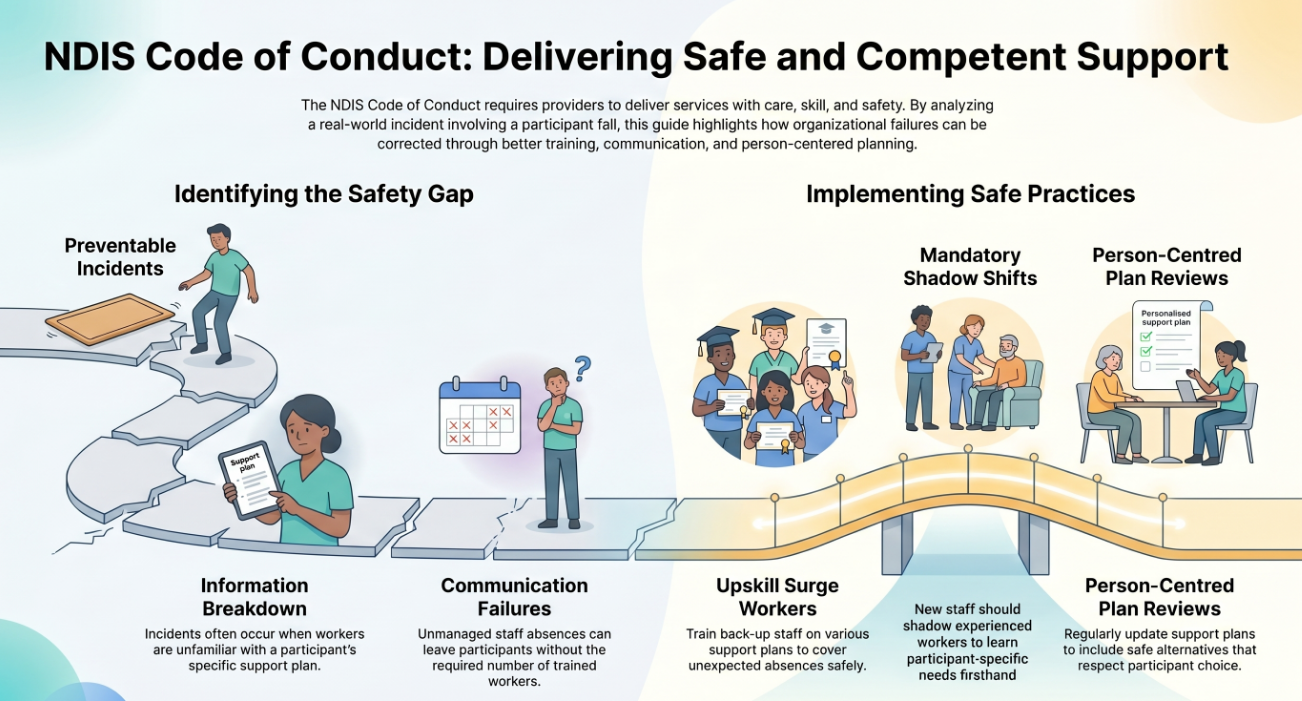
When an incident occurs, the immediate instinct is often to blame the individual worker. In Jordan’s case, Frank—a new support worker—attempted a shower alone, unaware that Jordan’s support plan mandated a two-person transfer. However, framing this as "worker error" ignores the broader reality of administrative negligence. Competency is not merely an individual’s intent; it is a provider’s duty of care to ensure the induction and supervision processes are impenetrable.
The failure here was systemic: the provider failed to ensure Frank was properly briefed on the specific requirements of Jordan's plan. Competency must be viewed as an organizational responsibility to adequately resource every shift. High-end providers avoid these failures by utilizing "shadow shifts," where new staff work alongside experienced team members to ground their skills in the participant's lived reality before they ever work solo.
"The Code states NDIS providers are required to provide supports and services in a safe and competent manner, with care and skill."
3. Takeaway 2: The Critical Role of "Surge" Systems and Continuity of Care
A provider’s true competence is not measured when everything is running smoothly, but when the plan falls apart. Jordan’s fall was precipitated by a breakdown in "surge" communication: a co-worker called in sick, the supervisor was never notified, and Frank was left to bridge the gap without the necessary resources.
This highlights the urgent need for organizational policies that manage unexpected absences without compromising safety. Upskilling a pool of "surge support workers"—staff who are trained in the specific support plans of participants they do not regularly see—creates a vital safety net for the NDIS principle of "Choice and Control." If a participant’s only options during a staffing shortage are an unsafe service or no service at all, the provider has failed to maintain the continuity of safe care. A robust surge system ensures that even in an emergency, the participant’s rights remain protected.
4. Takeaway 3: Choice and Control through Informed Consent and Creative Alternatives
Following Jordan’s accident, the subsequent support plan review offered a masterclass in rights-based practice. Safety and competency should never be used as excuses to limit a participant's life; rather, they should expand it. By identifying showering alternatives—such as dry bathing, washcloths, or baths—the provider increased Jordan's autonomy.
The critical factor here is informed consent. An advocacy-first approach requires workers to have the skill to negotiate these alternatives with the participant on days when a full shower may be unwanted or when resources are temporarily stretched. This elevates the support from a mere task to a dignity-preserving interaction. Competency, in this light, includes the professional ability to align technical skill with the participant's daily preferences, ensuring they remain the primary driver of their own care.
5. Conclusion: Moving Toward a Rights-Based Future
The NDIS Code of Conduct does not exist in a vacuum. It is supported by the NDIS Workforce Capability Framework, which provides the essential benchmarks for the skills and knowledge discussed here—such as the specific mechanics of a safe two-person transfer. These benchmarks remove the "guesswork" from support work, transforming abstract safety goals into measurable professional requirements.
As we look toward a future centered on disability rights, providers and workers must ask themselves a difficult question: Is your safety protocol designed to prevent paperwork headaches, or is it designed to empower participants? Transitioning from reactive safety to proactive competency requires a commitment to systemic oversight that treats every participant's safety as a non-negotiable right, not a stroke of luck.