Study Guide: NDIS Pricing Arrangements and Price Limits 2025-26
4/20/2026
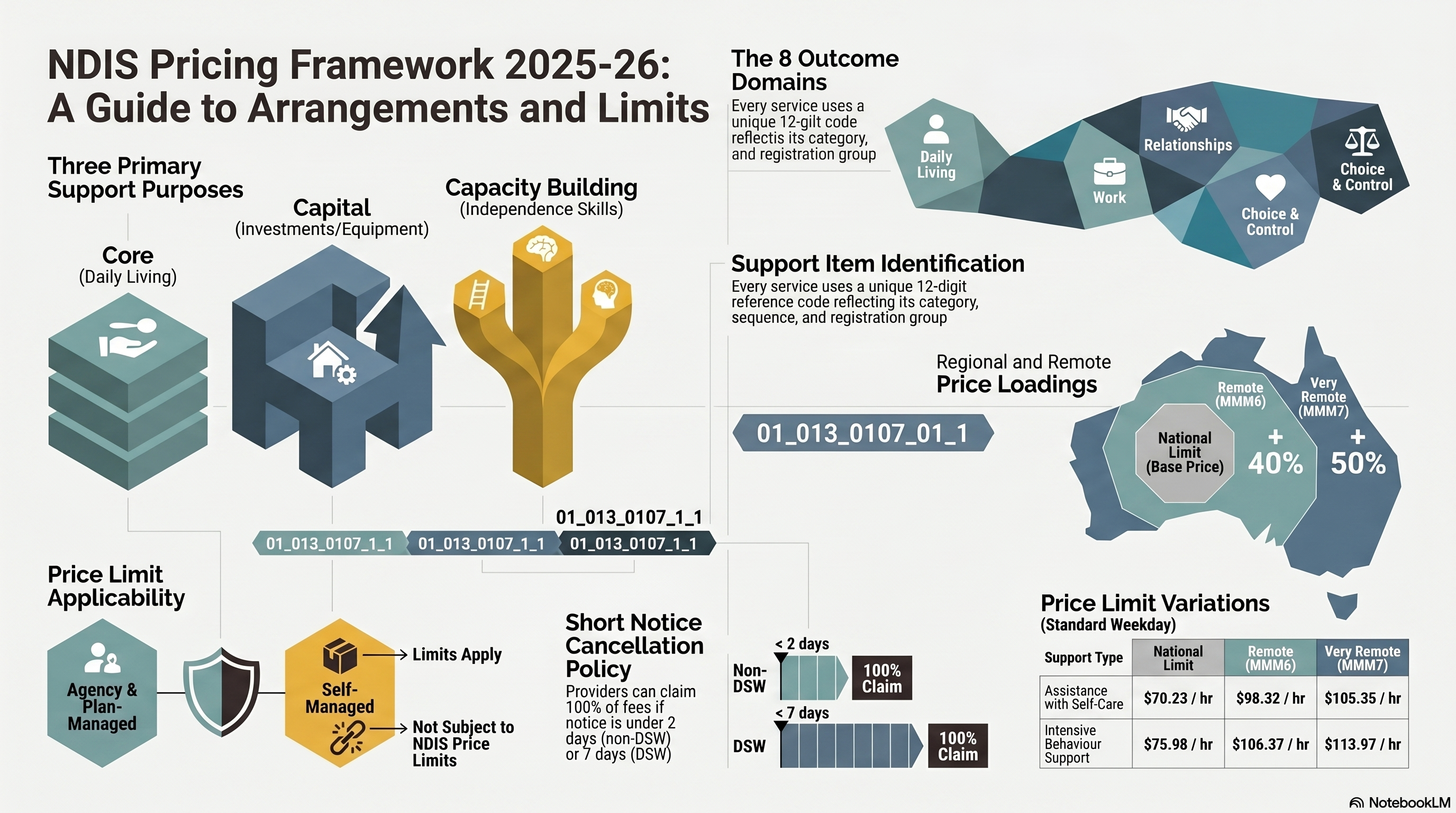
This study guide provides a comprehensive review of the National Disability Insurance Scheme (NDIS) Pricing Arrangements and Price Limits for the 2025-26 period, specifically based on Version 1.1 released in October 2025. It is designed to assist in understanding the regulatory framework, claiming rules, and support structures governing the NDIS.
Part 1: Short-Answer Quiz
Instructions: Answer the following questions in 2–3 sentences based on the provided source context.
- What is the primary purpose of NDIS price regulation and the "NDIS Pricing Arrangements and Price Limits" document?
- How do the requirements for claiming supports differ between Agency-managed, Plan-managed, and Self-managing participants?
- What does the NDIS Disability Support Worker (DSW) Cost Model estimate when determining price limits?
- Under what specific conditions can a provider claim for a "Short Notice Cancellation"?
- How is the Modified Monash Model (MMM) used to determine travel time limits and price loadings for providers?
- What are "Programs of Support," and what are the rules regarding their duration and exit conditions?
- What distinguishes "Level 1 Therapy Assistants" from "Level 2 Therapy Assistants" in terms of supervision?
- What are the specific rules for providers wishing to claim "Non-Face-to-Face" support provision?
- How does the NDIS define and categorize "Individualised Living Options" (ILO)?
- What is the "Isolated Towns Modification," and how does it affect the MMM rating of certain locations?
Part 2: Quiz Answer Key
- Purpose of Price Regulation: Price regulation is implemented to ensure that NDIS participants receive value for money when purchasing necessary supports. The document sets out general and specific pricing arrangements to assist both participants and providers in understanding how price controls and limits work within the scheme.
- Management Types and Price Limits: Agency-managed and Plan-managed participants must adhere to NDIS price limits, and Agency-managed supports must be delivered by registered providers. Conversely, self-managing participants can use both registered and unregistered providers and are not subject to the price limits or arrangements set out in the document.
- DSW Cost Model Components: The model estimates the fully loaded cost of a billable hour of support by accounting for base pay, shift loadings, leave entitlements, and salary on-costs. It also includes operational overheads (supervision, workers' compensation), corporate overheads, and a profit margin.
- Short Notice Cancellation Rules: Providers can claim up to 100% of the agreed fee if the participant provides less than two clear business days' notice for non-DSW supports, or seven days' notice for DSW supports. Additionally, the provider must be able to demonstrate they were unable to find alternative billable work and are required to pay the worker for the scheduled time.
- MMM and Travel Limits: The MMM classifies locations from MMM1 (major cities) to MMM7 (very remote); providers in MMM1-3 can claim up to 30 minutes of travel time, while those in MMM4-5 can claim up to 60 minutes. In Remote (MMM6) and Very Remote (MMM7) areas, there is no travel time limit, and price limits are increased by 40% and 50% respectively.
- Programs of Support: These are agreements for group-based or certain capacity-building supports where providers claim for agreed attendance regardless of actual presence, provided they had the capacity to deliver. These programs must not exceed six months, and participants must be allowed to exit with a maximum of two weeks' notice without further cost.
- Therapy Assistant Supervision: Level 1 Therapy Assistants must deliver support under the direct supervision of a qualified therapist at all times. Level 2 Therapy Assistants may deliver supports under indirect supervision, provided the therapist is satisfied the assistant can work independently after receiving specific training.
- Non-Face-to-Face Claiming: Providers can only claim for non-face-to-face activities if the support item allows it, the activity is specific to the participant (not general administration), and the participant has agreed to the charges in advance. Examples include writing reports about a participant’s progress, whereas making payment claims or staff rostering are considered non-billable overheads.
- Individualised Living Options (ILO): ILOs are support packages built holistically around a participant's preferences and strengths, separate from home ownership or SDA eligibility. They consist of two stages: "Exploration and Design," to create a suitable support model, and the "Support Model" itself, which combines formal and informal supports.
- Isolated Towns Modification: This modification reclassifies certain locations as "Remote" (MMM6) or "Very Remote" (MMM7) if they are enclaves surrounded by those areas, even if their standard classification is lower. For instance, towns like Broken Hill and Kalgoorlie are reclassified as MMM6 despite having lower standard MMM ratings.
Part 3: Suggested Essay Questions
Instructions: These questions are designed for in-depth analysis. Answers are not provided.
- Analyze the Conflict of Interest Framework: Discuss the responsibilities of NDIS providers in identifying, declaring, and monitoring conflicts of interest within the provider market as outlined in the NDIA Position Statement.
- The Impact of Remoteness on Service Delivery: Evaluate how the NDIS uses the Modified Monash Model and various price loadings to incentivize service provision in remote and very remote Australia.
- Core vs. Capacity Building Support Purposes: Compare and contrast the flexibility and intent of "Core" supports versus "Capacity Building" supports, focusing on how they align with the NDIS Outcomes Framework.
- Regulation of Specialist Disability Accommodation (SDA) and Supported Independent Living (SIL): Explain the distinct pricing structures for SDA and SIL, and how they interact to provide comprehensive housing solutions for participants with extreme functional impairments.
- Evolution of Employment Supports: Examine the transition from "School Leaver Employment Supports" to the current "Specialised Supported Employment" model, detailing the types of activities now claimable to help participants find and keep work.
Part 4: Glossary of Key Terms
Term | Definition |
Activity Based Transport | Costs associated with a provider transporting a participant to or from community activities, covering both worker time and non-labour vehicle costs. |
Agency Managed | A management type where the NDIA manages a participant's funds; providers must be NDIS-registered and adhere to price limits. |
Assistive Technology (AT) | Equipment or aids that assist participants to live independently or help a carer support the participant. |
Capital Support | Investments in high-cost items such as assistive technology, home modifications, or Specialist Disability Accommodation (SDA). |
Core Support | Funding intended to help participants complete activities of daily living and work toward their goals. |
Disability Support Worker (DSW) | A worker who provides direct care and support to NDIS participants, with price limits governed by the DSW Cost Model. |
Establishment Fee | A one-off fee claimable by providers who establish long-term (20+ hours/month) personal care or participation support arrangements with a participant. |
High Intensity Supports | Supports provided to participants with complex needs, requiring more skilled workers as defined by the NDIS Practice Standards. |
Irregular SIL Supports | Claims for unplanned or intermittent events that disrupt a participant's regular Supported Independent Living roster (e.g., the participant falls ill). |
Legacy Support | A support item that is being phased out; it cannot be used for new service bookings but may be used for existing ones. |
Modified Monash Model (MMM) | A geographical classification system used by the NDIS to determine price limits and travel caps based on a location's population and remoteness. |
myplace Provider Portal | The web-based system where registered providers manage service bookings and submit payment requests. |
NDIA | National Disability Insurance Agency; the organization responsible for delivering the NDIS. |
PACE | The new NDIS computer system for plan development and provider recording ("My Providers"). |
Plan Managed | A management type where a registered Plan Manager handles the financial administration of the participant's NDIS plan. |
Price Limit | The maximum amount a provider can charge for a specific NDIS support item in a given region. |
Registration Group | Categories of support (e.g., 0107 for Daily Personal Activities) that determine the standards a provider must meet to be registered. |
Service Agreement | A formal, plain-English contract between a participant and a provider outlining what supports will be delivered and at what price. |
Service Booking | A mechanism to set aside funding in a participant's plan for a specific registered provider (note: not required for PACE plans). |
Specialist Disability Accommodation (SDA) | Purpose-built housing for participants with extreme functional impairment or very high support needs. |
Supported Independent Living (SIL) | Assistance with daily life tasks in a shared living environment, focused on developing the participant's skills to live autonomously. |
Telehealth | The delivery of direct supports via video or telephone technology, subject to participant agreement and appropriateness of care. |
Unit of Measure | The standard of quantity for a support item, such as "Hour," "Daily," "Each," "Week," or "Month." |